Publikation
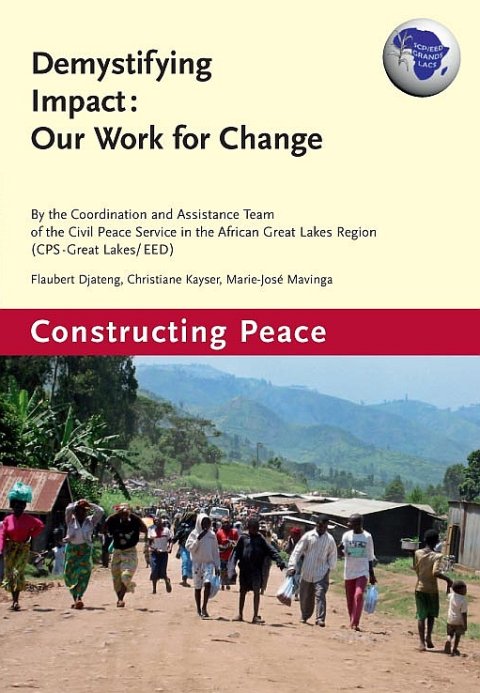
Demystifying Impact: Our Work for Change
The long-term stabilization process in DRC and the Great Lakes Region is almost entirely carried out by local activists. In an increasingly complex context, stabilization and peace efforts, emergency relief and development work intersect frequently in one single terrain. In this setting, local activists become the focal point of plans and actions that they are gradually less able to control. After several decades of aid mismanagement and inefficiency, donor agencies and other decision-makers require progressively more normative monitoring and evaluation procedures that fit in with their own systems and their own language. Impact has become a key-concept and a myth in this jungle, where the entire way of looking at your own work seems remote-controlled and barely adapted to daily reality. It is high time that local stakeholders demystify impact and take control of this vital matter: they need to devise well-tailored, personal ways to analyse and measure the desired and undesired changes that they induce. This is an essential condition for developing appropriate strategies and increasing efficiency.
Concerning the Civil Peace Service (CPS), professionals who are sent to conflict zones to support local agencies and institutions. They are supposed to make work more effective. Their work may be carried out in a wide variety of domains, (and not only in mediation or detraumatisation), provided that it becomes a stakeholders’ effort and enables progress towards transformation that encourages or fortifies stability and peace. We must constantly question the purpose of what it is we are doing wherever we are. It is then absolutely indispensable for our entire CPS program to look at impacts so that we can evaluate the orientation and progress of our work. The impacts of networking and exchange between stakeholders are as important for a country as vast and wartorn as the DRC as they are for the region.
In this first publication of our series “Constructing Peace”, the Civil Peace Service in the Great Lakes Region presents you with methods, examples and techniques that should help you demystify impact and develop your own way of measuring and analysing change. The assistance team of CPS has worked with these methods in different parts of the DRC and would like to share them so that you may apply, improve and adapt them in your various fields.
See as well: French Version